2026-27-02
AI Translation Tools: Benefits, Limitations and Enterprise Considerations
The Hidden Cost of General AI Translation Tools
AI translation tools can look like instant time-savers - especially when you’re under pressure to publish fast across languages. But for many teams, there are more considerations that just speed.
When translation happens through public, general-purpose AI tools, risk becomes unmanaged: sensitive content gets copied and pasted, access is unclear, and there is no audit trail. You can end up with IT or Compliance teams stepping in to pause or block adoption.
This article explains what secure, integrated AI translation should mean in practice - and how to evaluate options based on governance, workflow readiness, quality control, and accountability.
Why Some AI Tools Might Expose Your Business to Risk
Most enterprise risk comes from how translation is used, not from the idea of AI itself.
If teams translate by copying text into public, general-purpose AI tools, you lose the control layer that procurement and security teams expect: who accessed what, where content went, what policies applied, and how decisions were recorded.
A Common Failure: Translation Happens Outside Approved Workflows
Unmanaged translation usually looks like this: someone needs speed, they use a convenient tool that they might already be using for day-to-day work efficiency, like ChatGPT or Gemini to ask for translations, and the output gets pasted into a document or CMS.
Over time, terminology drifts, style becomes inconsistent, and review happens ad hoc - if it happens at all. Localization leaders end up with fragmented quality control, while IT and Compliance see an ungoverned data path.
What IT, Compliance, and Localization Teams Each Need to See
For many enterprises, a secure, integrated translation workflow needs to satisfy three perspectives at once:
-
IT and Security teams want access control, auditability, and a clear enterprise posture.
- Compliance, Legal or Procurement teams want defensible data handling and vendor accountability.
- Localization teams want control over terminology, easy integration and scalability.
You may have in the past wondered whether it was better to use ChatGPT, Gemini or Claude for translations - effectively comparing similar types of tools.
What might be more effective for your organization is considering whether this ad-hoc individual user based approach is too much of a risk compared to a governed workflow or a dedicated translation tool built by AI translation experts.

What Secure AI Translation Should Include
Secure AI translation starts with a simple principle. Treat translation as an enterprise workflow, not an individual action.
Access Control and Auditability
Generally, you should look for your AI translation to have:
-
Controlled access (ideally with SSO for enterprise environments)
-
Audit logs (who did what, when)
-
A workspace model that supports team usage and oversight
Data Handling Clarity
You should be able to know:
-
What data is processed, where and under which policies?
-
What is retained, and for how long?
-
Whether you have traceability to support audits?
Essential Questions to Ensure Secure AI Translations
While it may seem challenging to confront these security considerations, it doesn't have to come at the expense of speed.
Maintaining control of your data while accessing the benefits of AI translations is important. To that end, here are some questions you can ask:
-
Can you enforce access control and capture an audit trail?
-
Can the vendor explain data handling in a way that Procurement and Security teams can document?
-
Can you keep translation data inside an approved workspace instead of uncontrolled copy/paste usage?
-
Is there a defined path for higher-risk, business critical content?
Integration: Making Sure AI Translation Fits Your Workflows
While online tools might seem fast and useful for individual users carrying out their own translations, implementing their use enterprise wide so that they function with your existing systems and content workflows is more of a challenge.
That's why it's important to look for a translation platform that enables connectivity, such as through an API.
APIs and Workflow Fit
An AI translation platform will be ready for integration if it can provide:
-
Connectivity through an API to existing systems and workflows
- A model that can support repeatable processes, instead of one-off prompting
- The ability to scale from small use cases to broader programs
Team Management and Rollouts
A useful way to implement an effective translation tool or platform is to run a phased rollout. Start with priority use cases, deploy in waves, and run in parallel with existing workflows until it is fully up and running.
Quality Control at Scale: Controlling Terminology, Context and Review
While at first glance, the translation output from an online tool like ChatGPT or Gemini might appear "good enough", it can fall down on some critical issues.
How can you be sure of the quality if you don't have in-house native speakers? Or even if you do, is it really business efficient to have non-specialists reviewing your content?
Review is especially critical when content is regulated, such as for legal, finance or life sciences, or brand-critical - like marketing campaigns. And for the latter, terminology and context are vital to ensure your brand voice works across every language.
This is why your translation platform should enable quality, terminology and contextual control - as well as the option for human review.
Shared Context and Terminology Control
If your translations are happening across various colleagues or teams, you need shared rules:
-
A glossary or term base
- Rules, such as 'do not translate' terms
- Style guidance, brand guidelines that can be implemented consistently
As you might imagine, it can be extremely challenging to implement these company-wide if everyone is carrying out their own translations in their own ChatGPT account. Which is why using an enterprise translation platform with these built-in features can help.
Review Workflows that Match Content Risk
With a platform approach, you can also steer different content to different translation workflows based on its business risk and volume. For example:
-
Low risk, high-volume content can be served with self-service translation, which has embedded terminology, brand guidelines and context controls.
-
Higher-risk content can use a hybrid model, with AI translation and human revision. Perfect for marketing, product documentation, technical manuals or other customer-facing content at scale
-
Regulated content - such as critical healthcare, legal or public sector content - might have to be translated and reviewed by humans, for regulatory, legal, and auditability reasons.
Accountability: Support, Onboarding and a Scalable Path
A secure enterprise translation platform is more than just a UI. It gives teams a controlled workspace they can roll out with confidence - so translation doesn't live in ad hoc prompts or one-off workarounds.
Another benefit of choosing the right partner to provide that platform is that when your needs scale or content becomes more complex, you don't have to fully switch tools or rebuild processes.
You can expand from a platform into managed translation services, with governance and review built in for higher stakes content.
Use Case: Lia Go
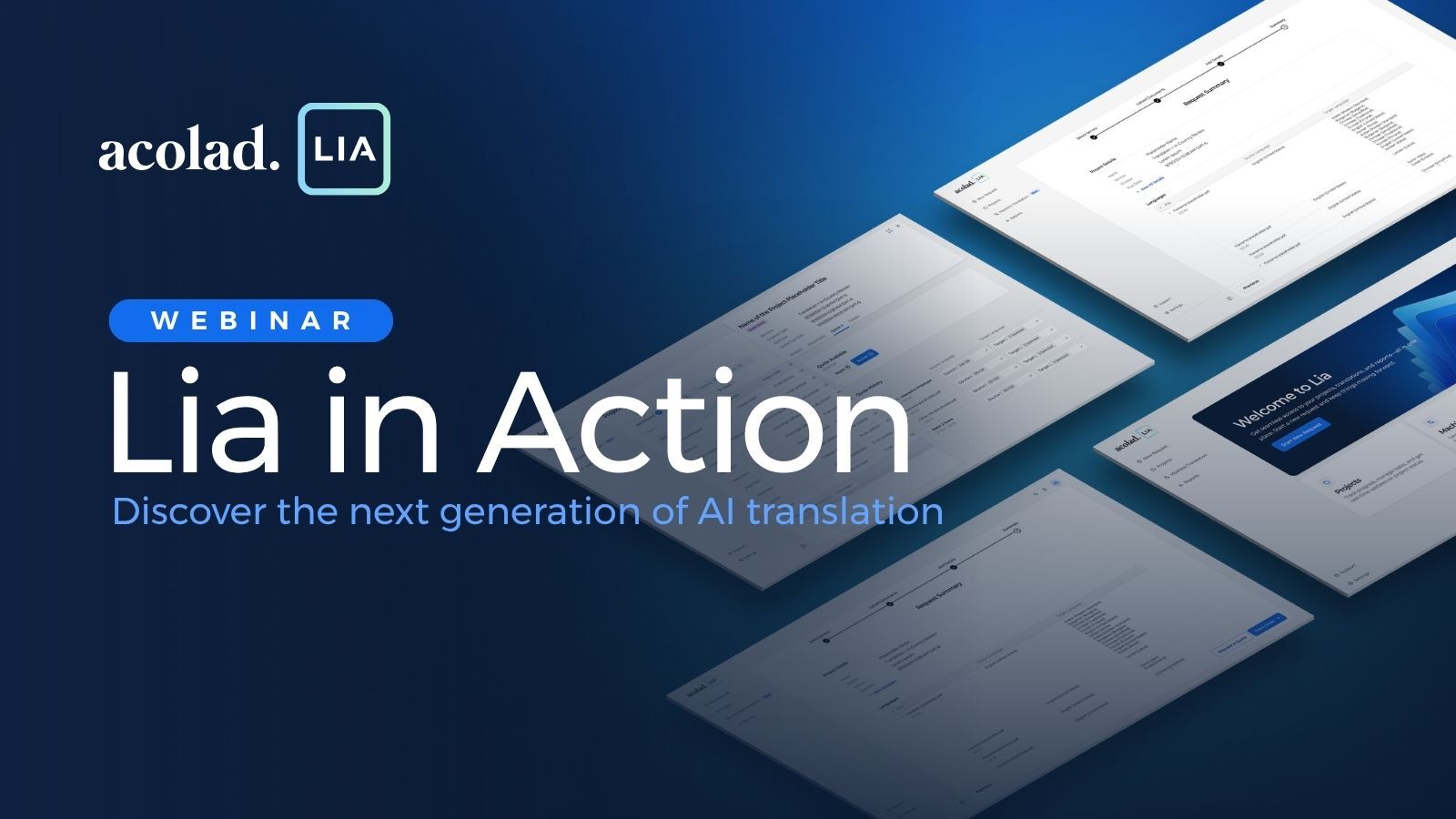
To demonstrate this system, let's look at the example of Lia Go and Lia Services.
Lia Go: Acolad's self-serve, subscription based AI translation platform to allow your teams to automate translations securely and autonomously.
Lia Services: Managed enterprise grade translations - designed to integrate with your systems and provide options for fully human or hybrid translation workflows.
You might start out by empowering your teams to carry out their own translations securely whenever needed through Lia Go. But when you require larger scale integrations, or a workflow designed to cope with sensitive business critical content, you can upgrade to managed AI translation services delivered through Lia Services.
Partnership That Provides Accountability, Onboarding and Support
When rolling out new tools for AI translation, success doesn't rest solely on output quality. What matters is a clear ownership for onboarding, a support path when teams get stuck, and defined ways to handle exceptions. That accountability makes it easier to roll out across different teams and stakeholders. All in all, this means that if you partner with an expert translation provider, you're also getting the support that can make your AI adoption much more likely to succeed.
A Practical Way to Structure AI Translation Considerations
The following checklist should help you evaluate potential partners for your AI translation needs, whether you need a platform or a deeper partnership approach.
-
Security and Governance
-
SSO or equivalent enterprise access controls
-
Audit logs and traceability for translation actions
-
Clear data handling position that Procurement can document
-
-
Integration Readiness
-
API integration availability
-
Workflow fit
-
Phased rollout support
-
-
Quality Control
-
Shared context, terminology controls and style guidance
-
Review workflows to match content risk
-
A clear policy for regulated, legal or brand critical content
-
-
Accountability
-
Named support model (who owns onboarding and governance setup)
-
Service expectations and escalation path for high-stakes content
-
Ability to move from self-serve to managed delivery
-
Key Takeaways
-
“Secure AI translation” is a governance requirement: access control, auditability, and clear data handling matter as much as output.
-
Evaluate tools on four themes: security/governance, integration readiness, quality control, and accountability.
-
For quality at scale, prioritize shared context, terminology controls, and risk-based review paths - not just “better prompts.”
-
High-stakes content needs a defined escalation model with traceability and expert oversight.
-
A decision checklist makes cross-functional approval faster because IT, Compliance, and Localization can validate the same criteria.
What makes AI translation secure?
A controlled translation workspace with access controls, auditability, and clear data handling - workflows for terminology, review and accountability help too.
Are public, general-purpose AI tools the best for translation?
It depends on your use cases, internal policies and content risk. For many organizations, using public tools can be a risk because sensitive or business critical content might be made public, and governance and traceability are limited.
How do we keep terminology consistent when using AI translation?
Shared context and terminology controls can be integrated into translation platforms like Acolad Lia. Glossaries, term bases and do not translate rules can help your content be translated more consistently.
What is the importance of accountability for an AI translation program?
Ownership for onboarding, governance setup, defined support paths and escalation options for risky or business critical content are all possible with an accountable partner for AI translation.