2026-10-03
Language as a Public Service: Key Lessons for Public Sector Interpreting
Interpreting Isn't a Support Function - It's Key to Public Service Delivery
If you work in healthcare, justice, policing, migration, asylum, or social services, you already know that language access isn’t just a “nice to have.” It’s how you deliver services safely and fairly.
Yet many institutions still buy interpreting as a block of hours - and hope the right interpreter is available when a patient shows up, a court hearing starts, or a social worker needs to act quickly. That approach can break down fast - especially when regulations tighten, demand spikes, or a rare language request hits an already stretched frontline team.
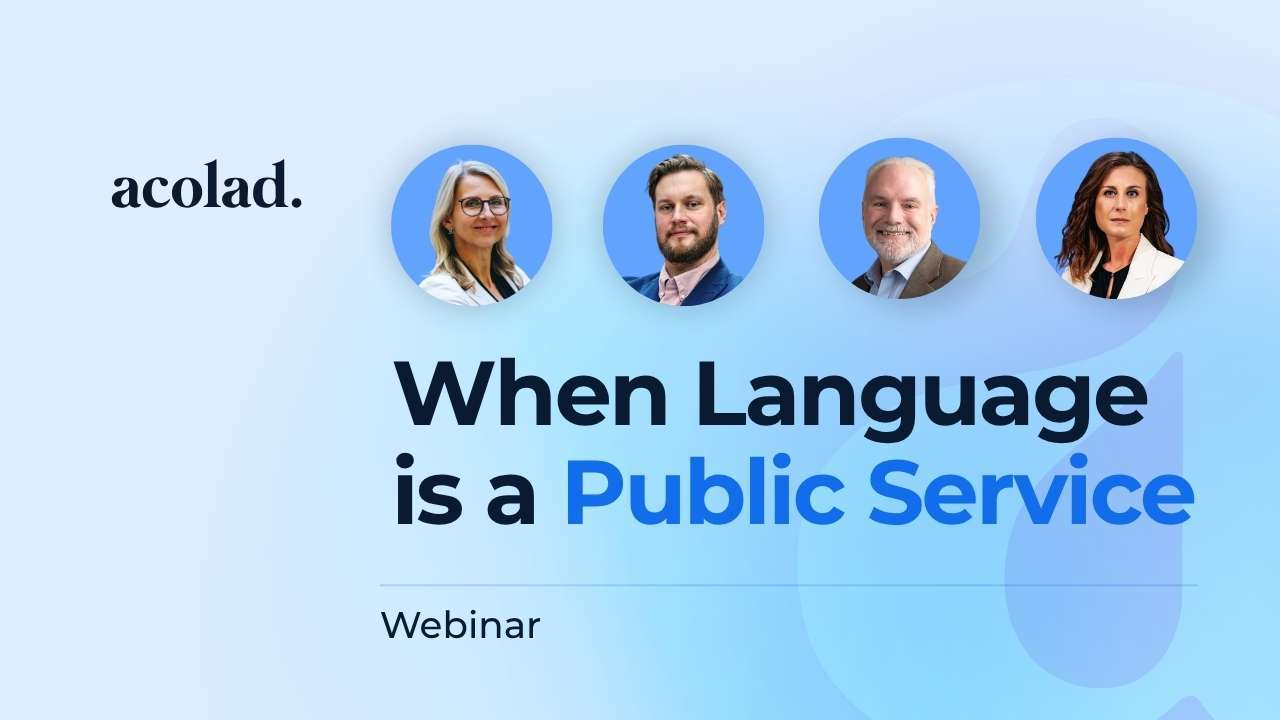
To discuss some effective examples of what works in real public-sector settings, Acolad brought together four expert interpreting voices in a webinar to discuss When Language is a Public Service.
Acolad's Nancy Hähnel (General Manager Netherlands), Chris Stypula (Senior Sales Director UK), Jim Pfeiffer (Senior Business Development Director US) and moderator Giulia Silvestrini (Head of Global Interpreting), shared their real-world insights into what makes interpreting for the public sector truly effective.
This article captures the most practical insights from that session, with perspectives from within the EU, UK and US.
Key Topics Covered
-
Why interpreting is core to public service delivery in high-stakes settings.
-
Interpreting as a public service capability, not a commodity: what breaks when it’s treated as “hours purchased,” and what to put in place instead.
-
Hybrid interpreting in practice: when to use on-site vs OPI vs VRI, and how to make the right option easy for frontline teams to access.
-
Procurement and governance that protect access: shifting from lowest cost to accountable value, managing risk and continuity, and setting the right KPIs.
-
Certification, quality, and availability: how to set workable standards without collapsing coverage - especially for certified and low-resource language needs.
-
Building long-term capacity: forecasting peaks, strengthening pipelines, and supporting interpreters to keep services resilient over time.
Why Interpreting Is a Public Service Capability - Not a Commodity
In our multilingual world, interpreting can be needed everywhere: a nurse triage call, a courtroom exchange, a police statement, an asylum interview. And because it touches so many services, it often ends up split across budgets and owners.
"Everyday interpreting services allow institutions to communicate with speakers of foreign languages in key domains, including healthcare, justice, education, migration, and asylum."
Giulia Silvestrini
That breadth of domains matters because it helps explain why interpreting is frequently “owned” by different teams across the same institution - each measuring success differently (cost, speed, risk, user experience).
The panel’s message was consistent: if interpreting is treated like a simple transactional purchase, problems show up on the front line - late bookings, missed coverage, inconsistent quality, and avoidable stress for frontline staff and citizens.
"Efficiency comes from treating interpreting as critical infrastructure for access, and not simply as a transactional service. When this is sorted, you have success coming."
Chris Stypula
Practical takeaway: This underlines why interpreting shouldn't always be managed as a single-team purchase. Decisions about quality, access, modality, and workforce sustainability affect multiple public services, so you need governance, perhaps from a partner, that holds up across different contexts.

Discover More Insights from the Webinar
What's Changing: Hybrid Delivery and Smarter Channel Choice
We're seeing that more and more public services are mixing on-site, phone, and video interpreting - often referred to as OPI (over-the-phone interpreting) and VRI (video remote interpreting). Often, they're keeping in-person support for the most sensitive conversations, while using OPI or VRI when speed and reach matter.
"We are seeing emerging hybrid models. Face-to-face remains critical for sensitive interactions, while OPI and VRI provide speed and nationwide reach, which is crucial for states as well."
Chris Stypula
The panel emphasized that “hybrid” only works within the right organizational setup. The question isn’t necessarily “remote vs on-site” in the abstract; it’s which modality best fits risk, urgency, complexity, and user needs - how easily your end-users can access the interpreting services.
Even the best procurement plan fails if frontline teams don’t know what to do in the moment.
"When they have someone who comes walking into the office, or comes into the emergency room, do they know what to do when they have someone who doesn't speak English? Whether they do phone, video, on-site first?
"What is the best way to implement that? And that's something really critical for an organization. It may be something where procurement knows exactly who to call. It may be even that the language service manager knows who to call, but if that doctor or nurse or that clerk of the court doesn't know who to call, what's the process, it becomes a very stressful situation for them."
Jim Pfeiffer
Practical takeaway: Choosing phone vs video vs on-site is a moment-of-need decision. If staff don't have a simple playbook and a clear way to connect, they lose time exactly when time matters.
Interpreting Procurement and Governance: Shifting From Lowest Cost to Accountable Value
Considering the interpreting procurement process for public sector organizations was a crucial part of the webinar conversation, especially because it shapes outcomes long after the contract is signed.
Cost control matters - but the cheapest hourly rate won't help if calls aren't answered, rare languages can't be filled, or quality issues create repeat visits and rework.
"In the UK public sector we're seeing a shift now from lowest cost procurement, more towards accountable value.
"I think a lot of our buyers are now evaluating their risk, trying to safeguard, focus on service continuity, and not look just at price per hour, which is also a driver."
Chris Stypula
Other considerations in many markets include a greater focus on security, technology and quality. Teams are being asked to prove how data is handled, how calls are routed, and how quality is checked - especially when cases involve health, legal risk, or vulnerable people.
"I for sure see an increase in security requirements, an increase in the role of technology, and a continuous urgent need in further defining what is quality and how can we measure quality in interpreting."
Nancy Hähnel
Practical takeaway: Governance and KPIs are where “quality vs efficiency” becomes operational. If KPIs reward only speed and cost, quality and coverage will degrade. If KPIs are designed around access and outcomes, teams can make better trade-offs - especially during peaks.
Interpreter Certification, Quality and Availability: Making Requirements Workable
Another key tension within public sector interpretation is that certification requirements protects quality - but if the rules are too rigid, you may end up with no interpreter available when you urgently need one. The trick is matched requirements to risk: highest-stakes cases get certified support, while lower-risk interactions still get qualified coverage.
The point was illustrated with a comparison that resonated across sectors: quality standards are essential, but the system must remain workable.
"You have states that license interpreters, which is a great thing. They need to make sure that the interpreters are qualified. In the United States, if you get a haircut or you get a massage, they have to have a certification. I think to ensure quality communication for a deaf or hard of hearing person, they need to have a qualified interpreter.
"However, if the interpreters don't go get that license, or don't have the time for that, that shrinks the labor pool, and it can make it tougher to get resources. That's where the technology can help as well."
Jim Pfeiffer
Nancy highlighted a shortage of certified interpreters in the Netherlands. Giulia added the wider implication: when qualified supply is limited, public services need clear rules on when on-site is essential, and how to protect coverage for low-resource languages.
"We can't deny that there is a shortage of resources, especially when it comes to certified interpreters. On the one hand, when it comes to on-site interpretation, especially for languages of lesser diffusion, we want to make sure that whenever it is critical to deploy an on-site interpreter.
"Those few on-site interpreters are available and can be deployed for the assignments for which it matters the most. And that's why investing in technology and deploying technology in the backend helps by making sure that interpreter selection is automated, and that resources will be deployed where it matters the most."
Giulia Silvestrini
Practical takeaway: When selecting an interpreting provider, consider whether they offer a technology platform that helps route each request to the best-fit interpreter - whether you need coverage for a low-resource language, or a certified interpreter for a higher-risk assignment.
Building Long-Term Interpreting Capacity: Forecasting, Pipelines, and Support
Resilience is also a key capacity for many public sector interpreting programs. Maintaining coverage as demand changes, peaks appear, and language needs evolve can be a real challenge.
Forecasting, and building models that can flex between structural demand and ad hoc peaks is critical.
"Predictive forecasting models are very important, being integrated with the institutions, with European law, with migration; asylum-seeking policy. Being in conversation with the respective organization to be able to predict, and then have a model that works for basically any need, whether it's structural or an ad hoc peak need."
Nancy Hähnel
Nancy gave the example of Acolad Academy, in the Netherlands, where a system kicks in whenever a peak is identified, either temporary or structural in an effort to maintain an effective supply of interpreters.
"What we do in the UK, and that works, is build community pipelines, so partner with diaspora communities, universities, interpreter academies. As Acolad, we create entry pathways for bilingual speakers into professional interpreting."
Chris Stypula
In practice, resilience can be built by organized providers who can turn forecasts and pipelines into operational readiness - investing in interpreters so that the right one is available when demand spikes.
Practical takeaway: Ask providers to show you how they forecast peaks and maintain their interpreter pool, and require a routing or matching setup that prioritizes certified and low-resource requests when it matters the most.
Building Resilient Interpreting for the Public Sector
-
Plan interpreting like an essential service: clear ownership, clear escalation rules, and a simple way for staff to connect.
-
Use hybrid delivery intentionally: keep on-site for sensitive contexts; rely on OPI/VRI for speed, reach, and coverage.
-
Write contracts around access and outcomes: can you fill requests quickly, cover rare languages, and maintain quality during peaks - not just deliver minutes at a low rate.
-
Make certification requirements workable: protect quality without shrinking supply beyond what services can sustain.
-
Build resilience through forecasting, community pipelines, and interpreter support (training, growth paths, well-being).
More questions about public sector interpreting? We have answers.
How do you set quality standards for public sector interpreting without reducing coverage?
Use risk-based requirements (where certification is essential vs. where qualified supply is acceptable), and align modality choices (on-site/OPI/VRI) to the context.
What KPIs best indicate whether language access is working?
Prioritize access-oriented measures such as time-to-assign, fill rate by language/credential, and performance during peak periods - alongside quality monitoring.
How do you plan for peaks and low-resource languages in interpreting demand?
Combine forecasting with a sustainable supply strategy (pipelines, training pathways, and routing/matching processes that prioritize urgency and credential needs).
What does “outcome-based procurement” mean for interpreting?
It means defining success by citizen/patient experience and access, then building governance and KPIs around those outcomes - not only around utilization and cost.
How can an interpreting program protect quality without losing coverage?
Clarify qualification requirements, set risk-based rules for when certification is needed, and use hybrid delivery models to expand access - while also investing in training pathways to grow supply.