How Structured Content Scales Regulatory Submissions
Why the Old Document-Based Model No Longer Works
Most regulatory teams still work with Word files, PDFs, and lengthy review cycles. That approach slows down the submission process and creates unnecessary risk:
- Copy-paste workflows make labeling and safety updates inconsistent.
- Global submissions get delayed.
- Compliance costs rise (often 5% to 9% of annual revenue).
- Translations multiply errors and manual checks.
Documents are the bottleneck. The key is to treat content as reusable data rather than static files.
“The mindset is to get out of the trap of a document and think about the knowledge capture and the information."
Regina Lynn Preciado, Vice President of Content Strategy Solutions, Content Rules
How Structured Content Fixes the Problem
Treat content as structured, reusable data - not as documents. Structured Content Authoring (SCA) separates information from formatting and breaks it into reusable “components” – words, phrases, paragraphs, images, videos, or tables. The result is simpler, cleaner, and faster workflows for technical content.
This is the foundation of a new regulatory, clinical, and labeling ecosystem:
- Content becomes reusable instead of being rewritten
- Quality and consistency improve instantly
- Compliance risk drops
- Reviews get easier
- Global teams collaborate without chaos
- Operational costs go down
- Submissions scale faster
Structured content is not a tool. It’s the operating system that life sciences companies need to stay competitive over the next five years.
The CCMS: Your Single Source of Truth in Action
A Component Content Management System (CCMS) is the technology that stores, manages, and tracks every content component. Think of it as a central brain for all your regulatory content. When you make a change in a source component, that update flows automatically through every document where it appears.
The following infographic shows an ideal structured content workflow for a clinical protocol.
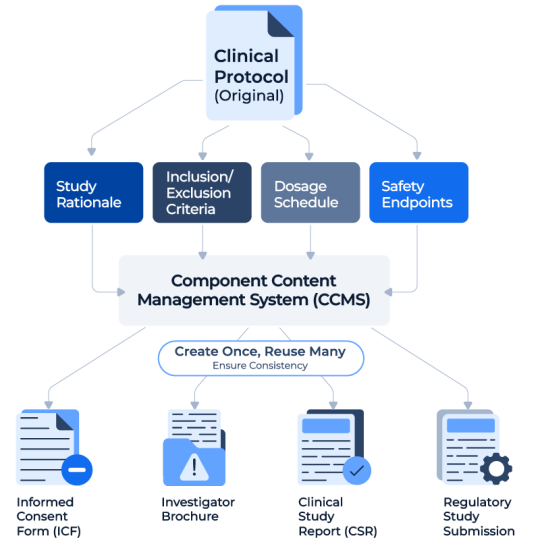
"By structuring the protocol, components are automatically reused in up to 50–70% of other regulatory documents, such as the Informed Consent Form (ICF) or the Investigator Brochure."
Regina Lynn Preciado, Vice President of Content Strategy Solutions, Content Rules
CCMS gives organizations something they have been missing: a way to treat their knowledge as reusable, governed data.
What a CCMS does:
- Keeps all components in one place
- Manages versions and approvals
- Adds metadata for product, region, or regulatory rules
- Tracks where each component is reused
- Integrates translations
- Enforces consistency across languages and markets
- Secures a Single Source of Truth (SST)
Why Regulators Are Forcing Digital Transformation
Look closely at eCTD v4.0 or IDMP. The message is clear: future regulatory submissions will be data-driven, not document-driven. The updated ICH eCTD v4.0 introduces unique identifiers, controlled vocabularies, and more flexible structures - all aligned with the principles of structured content. Not Word files or PDFs.
Regulators know documents cause errors: slow down reviews, hide inconsistencies, resist automation. Structured, validated data does the opposite. This is why the industry feels such urgency. Companies are not choosing structured content as an upgrade. They are moving to it because regulators are rewiring the rulebook around it.























.jpg)