2026-05-12
AI Translation: What Enterprises Need to Control Before They Scale
Enterprise teams are already using AI for translation, but many are still working out how to control it. The pressure is easy to understand: global content volumes are rising, teams need faster turnaround, and AI tools now appear inside everyday workflows. But speed alone doesn't solve the harder questions. Who owns quality? Where does sensitive data go? Which content can be automated, and which content needs expert validation before it reaches customers, regulators, or employees?
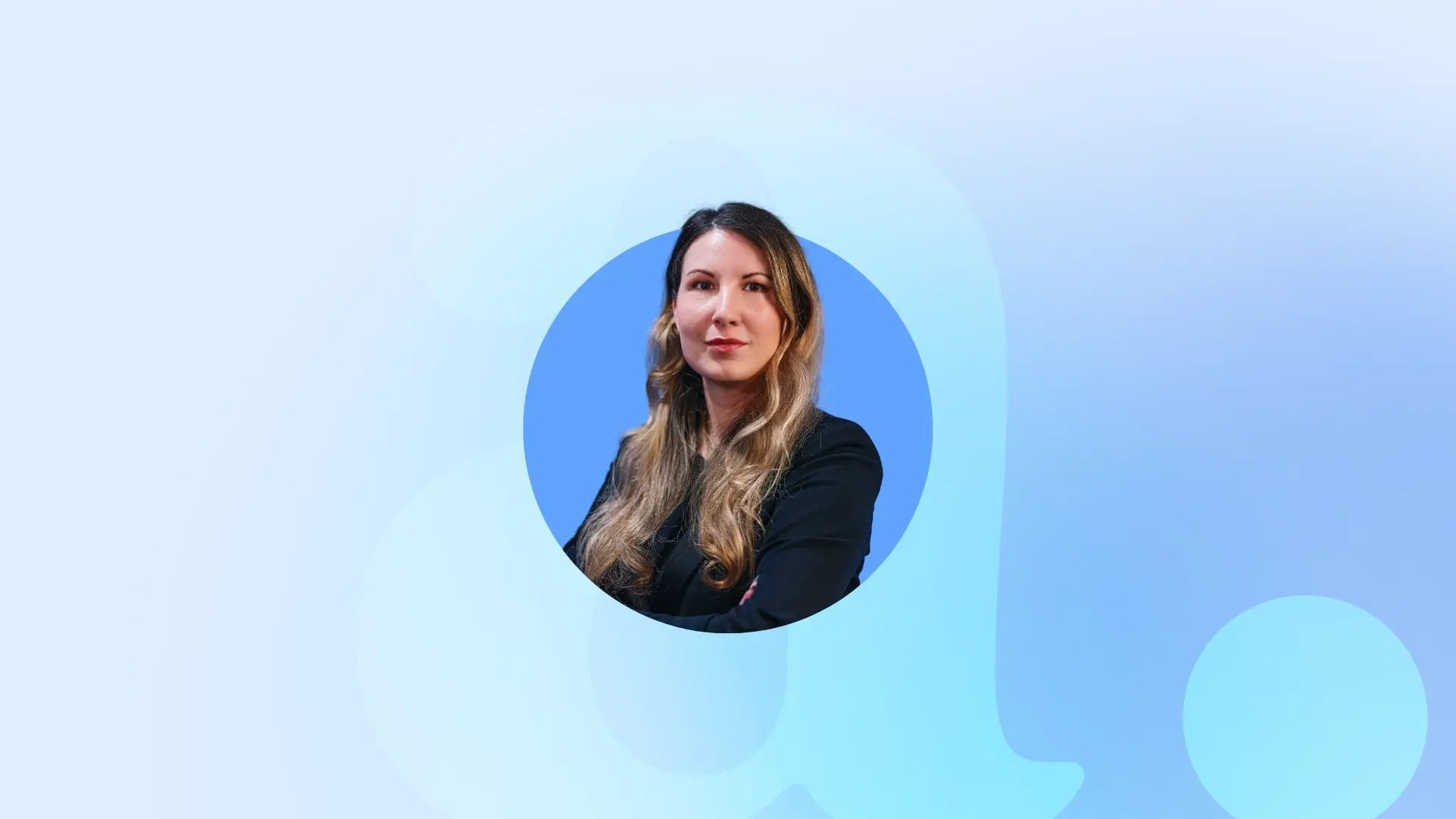
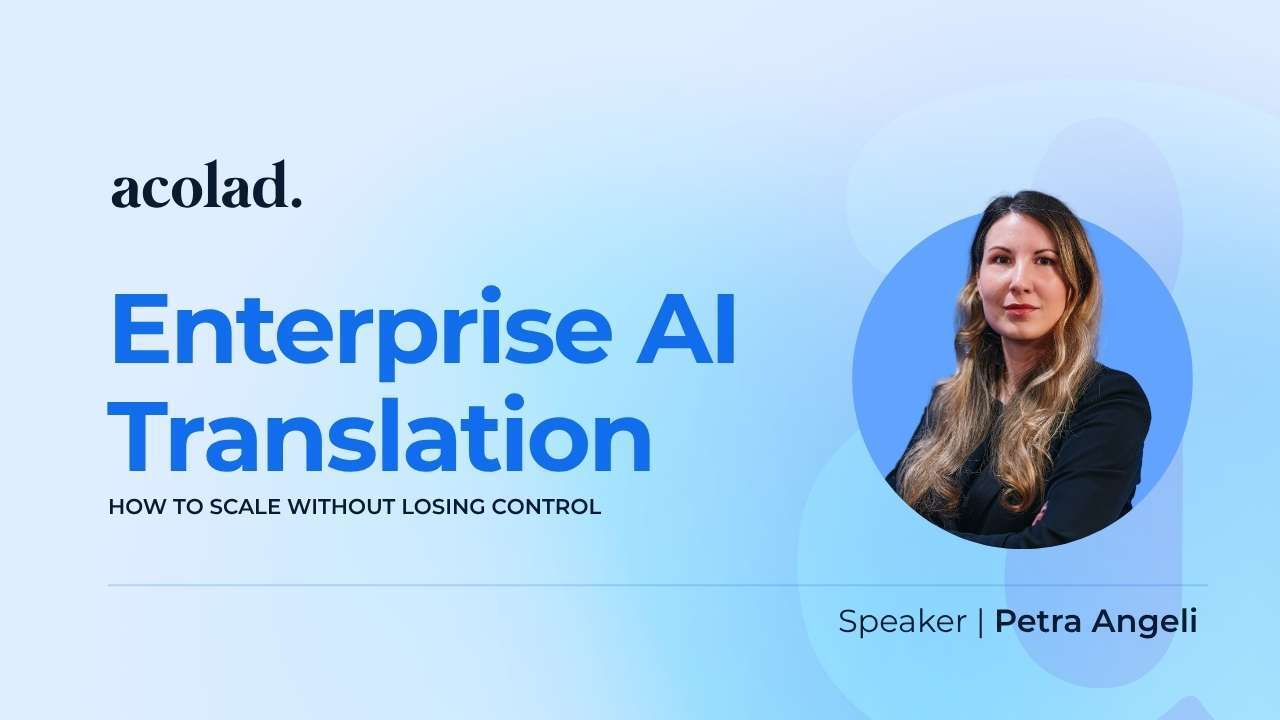
These were the questions Petra Angeli, Head of Global Solutions at Acolad, addressed in our webinar - Enterprise AI Translation, How to Scale Without Losing Control. Drawing on her work with global organizations, Petra focused less on what AI can produce and more on what businesses need to govern: security, accountability, workflow integration, and the quiet failures that can hide inside fluent AI output.
AI Translation Has Moved From Experimentation to Control
For large global businesses, the question is no longer whether AI can translate content. The harder question is how to scale AI translation without losing control of quality, data, brand meaning, and compliance.
Leaders are under pressure from two directions. Boards expect AI to reduce localization cost because translation now appears inside many tools. Legal and security teams see the same shift as a new risk surface, especially when sensitive content moves through systems without clear ownership or audit trails.
That tension changes the role of localization. Translation can’t be treated as a standalone service or a simple production step. At enterprise scale, it becomes a managed system of technology, data, human expertise, workflows, and accountability.
"The goal isn't just to buy translations anymore. It is also to orchestrate a complex ecosystem of technology, data and expertise."
Petra Angeli
The Answer Economy Makes AI Localization a Brand Risk
The answer economy is a search environment where users get answers directly from AI summaries, search results, or assistants instead of visiting the original website.
That shift away from traditional search behavior matters for global brands because users may never see the carefully approved source page. They may only see an AI-generated summary of product, safety, policy, pricing, or service information. If that summary contains outdated, mistranslated, or hallucinated content, the user may still treat it as the brand’s official answer.
For multilingual organizations, this raises the stakes. Localized content doesn't just need to be accurate on owned channels. It also needs to be structured, governed, and kept consistent enough that AI systems can interpret it correctly.
Petra referenced 2026 search metrics stating that 80% of search queries now result in zero clicks, and CSA Research data stating that 76% of global consumers demand information in their native language, while 40% walk away if a site isn't localized. These figures should be validated against the original sources before publication. Her underlying point is still useful for the article: global users expect instant answers in their own language, and enterprise brands need governance over the content AI systems may synthesize.
"It matters because the user never sees your source of truth. They only see the AI synthesis of your brand and if that synthesis contains a quiet failure, maybe a hallucinated spec or an outdated price or a version-mixed safety instruction... that user has really no way of knowing."
Petra Angeli
Shadow AI Turns Speed Pressure into Security Exposure
Shadow AI is the use of AI tools outside approved enterprise systems, policies, and security controls.
Shadow AI often starts with a practical problem. A regional team needs a deck, campaign, product update, or internal document translated quickly. The approved process is secure, but it may feel too slow for the business deadline. A high-performing employee opens a public AI tool and uploads sensitive material to get a fast draft.
That action may feel harmless to the employee. For the organization, it can expose unreleased product information, internal pricing, customer data, strategic plans, or regulated content. It can also remove the audit trail that compliance teams need when they ask where data went, who accessed it, and how it was processed.
The answer is not to rely only on bans. Enterprise teams need approved AI translation workflows that are fast enough to use, secure enough to govern, and clear enough to audit. In practice, that means centralizing access, controlling data flow, logging activity, and connecting AI translation to review and publication workflows.
"In the eyes of a high performer trying to hit a deadline, that official process really just looks like a roadblock. So what do they do? They don't need to be a security risk. They aren't trying to violate corporate policy.
They are high performers trying to do their jobs. So they go, they open a browser tab, they go to a free public LLM, maybe Chat GPT, and they paste the strategy deck that contains unreleased product features, internal pricing models and perhaps a five year roadmap data just to get a quick draft."Petra Angeli
Quiet Failures Make Fluent AI Output Harder to Trust
Quiet failure is an AI error that looks fluent, polished, and credible, but is factually, legally, or semantically wrong.
This is one of the most serious risks in enterprise AI translation. Older machine translation errors were often visible. Reviewers could spot awkward phrasing, missing grammar, or unnatural word choices. LLM output can look much better. That creates a confidence problem: the more fluent the output looks, the less likely a human reviewer may be to compare it carefully against the source.
Petra explained that LLMs are prediction engines, not fact engines. They predict likely language patterns. In translation, that can become a problem when the model treats the source text as a suggestion rather than an instruction. If a newer specification appears less often in training data than an older one, the model may favor the more common pattern. The result can be a fluent but wrong translation.
The answer, says Petra, lies in not treating AI output as finished translation. Instead, it's a candidate draft, especially when content affects safety, legal meaning, compliance or brand trust. That means building review around risk-based validation, something we'll look at shortly.
This is especially serious for regulated industries, technical documentation, legal content, healthcare information, aerospace, energy, and medtech. The risk is not limited to mistranslated numbers. It can include a small shift in legal meaning, a changed warning, or a verb that weakens an obligation in one market.
"But an LLM produces output that is so elegant, it triggers a fluency bias in the human reviewer. The better the translation looks, the less likely the human will interrogate the facts against the source."
Petra Angeli
AI Governance Is Now a Legal and Brand Responsibility
AI-generated content doesn't remove enterprise responsibility. If an AI system gives customers, employees, technicians, or partners the wrong information, the organization may still own the outcome.
Petra used public examples to explain this risk. One example was an airline chatbot that gave a passenger incorrect policy information. Another was a legal filing that included invented legal precedents. A third was automated translation of product listings that failed to account for cultural context. These examples should be validated against public sources before publication, but they help explain the same governance lesson: AI errors become enterprise errors when they reach customers, courts, employees, or markets.
For localization teams, this means AI output needs ownership. Someone must define which content is safe to automate, which content needs expert review, and which content requires strict validation before release. This is especially important for customer-facing content, regulated documentation, legal disclaimers, product safety information, and high-visibility user experience copy.
"The court ruled that a brand is legally responsible for its output, regardless of the author. The judge effectively said: the machine is yours, so the mistake is yours. You cannot delegate your legal liability to an algorithm."
Petra Angeli
Scalable Localization Depends on Workflow and Risk-Based Validation
Many enterprise buyers focus first on the model: GPT, Claude, Gemini, DeepL, or a custom system. But, as Petra argued, the model is only one part of the solution. The real scaling problem is often workflow. If teams still copy content from a CMS into an AI tool, paste it into documents, email it to reviewers, and manually reinsert it into systems, the business has moved the bottleneck rather than removed it.
Headless localization is a workflow where content moves from creation to secure AI orchestration to review and publication without manual copying and pasting.
For large organizations, this requires API-first integration with systems such as a CMS, PIM, code repository, or content supply chain platform. It also requires a clear validation model.
Risk-based validation is a review model that matches the level of human oversight to the risk of the content.
Low-risk, high-volume content such as basic metadata or standard product descriptions may be suitable for greater automation. High-risk content such as healthcare information, legal disclaimers, regulated product information, safety instructions, or corporate policy needs stronger validation. In some cases, that means subject matter expert review, human checks, and recurring audits.
This also changes how localization leaders report value. Instead of reporting only speed, volume, or cost reduction, they can report risk mitigated. That can include issues caught before publication, high-risk content routed to expert review, and AI output stopped before it reached the market.
"To reflect strategic value that you provide to your C suite, I would recommend that you start talking about risk mitigated. Report on your catch rate. You can talk and tell your leadership: Our governance layer stopped forty critical errors per one hundred pages.
When you show them the errors you caught, those quiet failures that I talked about, the hallucinated clearances or the ghost specks, you can prove that the expensive human review process isn't a bottleneck, it's actually a safety feature.
You aren't slowing down the process. You're armoring the company against a recall or a lawsuit."
Petra Angeli

Key Takeaways
-
AI translation governance helps enterprises scale multilingual content without treating every asset as the same level of risk.
-
Shadow AI often starts with business urgency, so approved tools must be secure, fast, and easy to use.
-
Fluent AI output can hide quiet failures, especially in regulated, technical, legal, and safety-related content.
-
Enterprise AI localization needs workflow integration, auditability, and human validation where risk is high.
-
Localization leaders can make their value clearer by reporting risk mitigated, not just words processed or cost saved.