




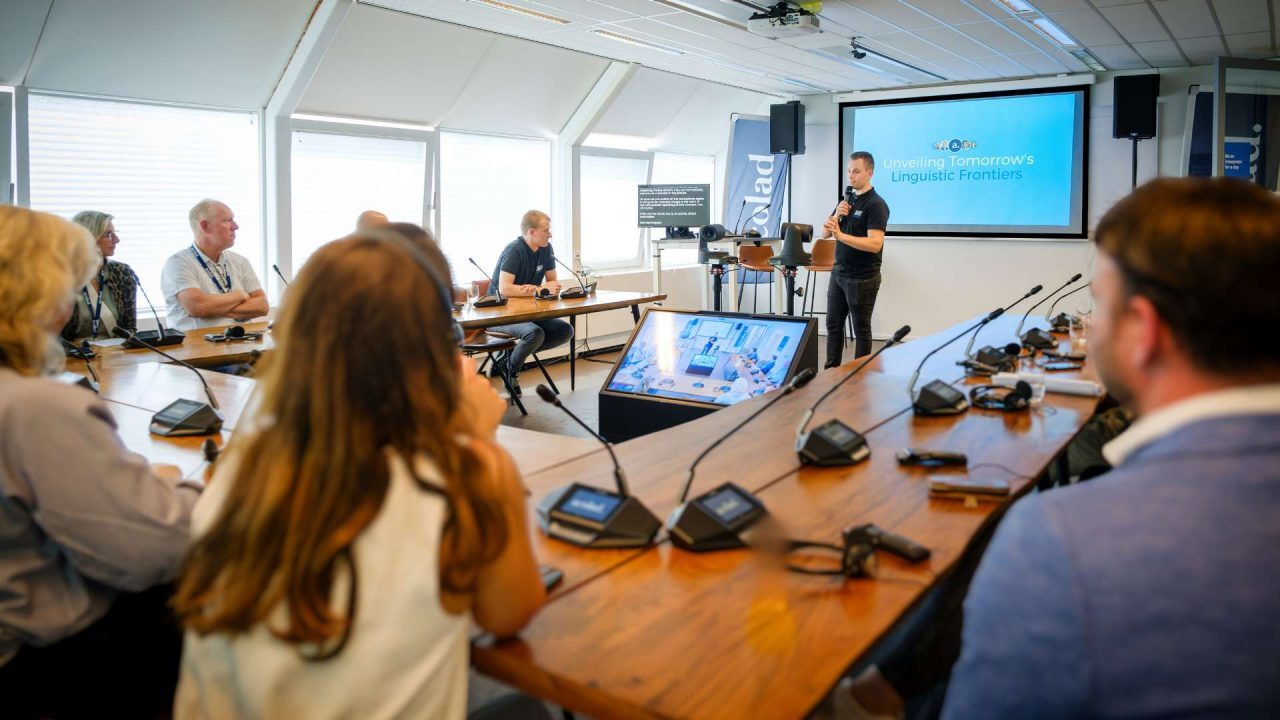
When no single party owns the full delivery chain at a multilingual event, interpreting fails. Not because an interpreter makes an error, but because the platform, the audiovisual (AV) setup, and the interpreter team are managed by separate vendors with no shared accountability.
Event interpreting covers simultaneous, hybrid, and on-site delivery for conferences, summits, and corporate events. This article explains what causes delivery failures and how to prevent them.
Why Event Interpreting Fails Under Live Conditions
A live multilingual event runs on several interdependent components: the RSI platform, the interpreter team, the AV infrastructure, the on-site technician, and a contingency plan if any of them fail. In most setups, these are managed by separate vendors.
When something goes wrong during a live session, the question is immediate: who owns the fix? If that answer isn’t clear before the event starts, no one owns it during the event.
A language channel that doesn’t activate for a plenary session. An RSI platform incompatible with the AV setup on site. An interpreter who can’t connect before the opening. Each of these is a visible, real-time failure in front of an international audience. It reflects directly on the organizer, and there’s no recovery window once it happens.
The risk at a multilingual event goes beyond technical failure - it can damage your reputation.
What Working With a Single Provider Actually Changes
When you work with a single provider for a multilingual event, you have one point of contact for every component of the delivery: the interpreter team, the platform, and the AV setup on site. If something goes wrong during a session, you don’t spend time working out which vendor is responsible. You call one number, and the fix is that provider’s problem to solve.
That also means one contract, one set of SLAs, and one reporting view after the event. Not three separate supplier relationships, each covering their own scope and stopping there.
For events at scale, this matters concretely. At COP30, Acolad delivered 885 interpreting sessions over 11 days across multiple language pairs and session formats - the kind of operational scale that leaves no room for coordination gaps between vendors.
On-Site, RSI, and Hybrid: Matching Format to Risk Profile
The delivery format follows the event type and its risk profile.
On-site interpreting with interpreters in booths is required when physical presence is part of the protocol, when the event involves high-stakes diplomatic settings, or when the AV environment doesn’t reliably support a remote connection. It remains the standard for high-stakes international events where any technical dependency is an unacceptable risk.
RSI suits corporate summits, international board meetings, and distributed events where participants join from multiple locations. Interpreters work from a hub or remote setup. Participants receive audio via an app or platform. RSI has expanded what’s achievable without full booth infrastructure, including hybrid formats where some participants are on-site and others are remote.
Hybrid delivery combines both. On-site interpreters cover main plenary sessions. RSI supports breakout sessions or additional language pairs where full booth coverage isn’t justified by attendance volume. This is increasingly the default for large events managing multiple languages across multiple rooms.
Three Questions to Ask Before Finalizing Your Event Interpreting Approach
Before finalizing your interpreting approach, it’s worth asking three questions. The answers will tell you whether a provider can actually own the delivery, or whether they’ll hand the problem back to you the moment something goes wrong.
First: who owns the contingency plan? A provider who delivers interpreters but doesn’t control the platform or AV setup can’t own what happens when one of them fails. Ask explicitly what the escalation process is if a booth feed drops or an interpreter can’t connect. If the answer involves calling another vendor, that’s an accountability gap.
Second: how are interpreters matched to specialized content? A summit with technical or policy-specific content requires interpreters with domain expertise, not just language coverage. The vetting and matching process is a direct quality indicator.
Third: what does post-event reporting look like? For organizations running recurring events, reporting by session, language pair, and quality indicator is how the service improves over time. A provider who can’t generate that data isn’t managing a service: they’re executing a one-off.
Key Takeaways
-
Most event interpreting failures are coordination failures, not interpreter errors. When multiple vendors share delivery without a single accountable party, no one owns the problem when it surfaces live.
-
Working with a single provider means one contract, one SLA, and one point of contact for interpreters, platform, and AV. You don’t manage the coordination: your provider does.
-
On-site interpreting remains the standard for high-stakes international events with diplomatic, regulatory, or AV-dependency constraints. RSI suits distributed and hybrid formats. Hybrid delivery combines both based on session risk profile.
-
Before contracting, verify who owns the contingency plan, how interpreters are matched to specialized content, and what post-event reporting covers.
-
The risk at a multilingual event isn’t technical failure. It’s reputational failure in front of an international audience with no recovery window.




















































































































.jpg)
%20(1).jpg)










.jpg)