





Choosing an AI translation tool for your enterprise isn't just about the most accurate engine. It's about fit: on-brand, secure, governed, and ready to scale. The best AI translation tools in 2026 differ sharply on those points. This guide compares 13 tools against the five criteria that decide enterprise fit.
What Factors Are Important for Enterprise Buyers
Accuracy isn't the whole decision. In Slator's 2026 buyer survey, output quality ranked first at 28%. But cost efficiency (20%), compliance and enterprise risk control (18%), and safe AI deployment (14%) together outweighed it. The priority isn't fluency alone, it's translation you can control.
A feature list is informative, but won't answer the question on its own. More than any accuracy score, the right tool depends on how it handles your brand, your data, and your review process.
The Five Criteria That Decide Fit
Five criteria can help you decide whether an AI translation tool fits an enterprise team.
-
Self-serve access means any team can translate on demand, without a ticket or a vendor project.
-
Brand grounding is built-in translation memory and glossary control, so output stays on-brand. Translation memory is a store of past approved translations, reused automatically.
-
Human review on the same platform means you route content to expert linguists without leaving the tool. This is the human-in-the-loop model, where experts check AI output before it ships.
-
Multimodal coverage means one tool handles documents plus audio and video, not text alone.
-
Enterprise governance is an audit trail, approval workflows, and usage visibility across every team.
The Best AI Translation Tools in 2026, Compared
Grouped by the job each tool does best, then scored against the five criteria. Yes means the capability is built in. Partial means it's add-on or limited. No means it's not offered by design.
| Tool | Family | Self-serve | Brand grounding | Human review, same platform | Multimodal (docs + A/V) | Enterprise governance |
|---|---|---|---|---|---|---|
| DeepL | MT engine | Yes | Partial | No | Partial | No |
| MT engine | Yes | Partial | No | Partial | Partial | |
| Microsoft | MT engine | Yes | Partial | No | Partial | Partial |
| OpenAI (GPT) | LLM assistant | Yes | No | No | Partial | No |
| Claude | LLM assistant | Yes | No | No | Partial | No |
| LILT | Adaptive AI + human | Yes | Yes | Yes | Partial | Partial |
| Lara (Translated) | Adaptive AI + human | Yes | Partial | Partial | Partial | Partial |
| Smartling | TMS platform | Yes | Yes | Partial | Partial | Yes |
| Phrase | TMS platform | Yes | Yes | Yes | Yes | Yes |
| Smartcat | TMS platform | Yes | Yes | Yes | Yes | Partial |
| Language Weaver (RWS) | LSP platform + AI | Yes | Yes | Partial | No | Partial |
| GlobalLink AI (TransPerfect) | LSP platform + AI | Yes | Yes | Yes | Partial | Yes |
| Lia Go | Enterprise managed AI | Yes | Yes | Yes | Yes | Yes |
What the Comparison Shows
Raw engines and public LLMs are fast, and anyone can use them without a project or a ticket. What they don't offer is built-in translation memory, a clear route to human review, or governance, so their output tends to drift off-brand and leaves no audit trail once several teams are working in it.
Localization platforms are built to close that gap. Smartling, Phrase, and Smartcat all add translation memory, review steps, and governance, and several of them now handle native audio and video too. Judged on features alone, the top platforms look fairly similar.
That's why the feature list isn't really the deciding factor. For regulated or high-stakes content, the thing that sets these tools apart is the operating model behind the platform. A software-only platform gives you the workspace but expects your team to staff the review, while a managed model gives you the same workspace along with expert linguists and accountability for the final output.
It's a distinction that carries real weight when a translation error could have legal or commercial consequences.
Why Enterprise Teams Choose Lia Go
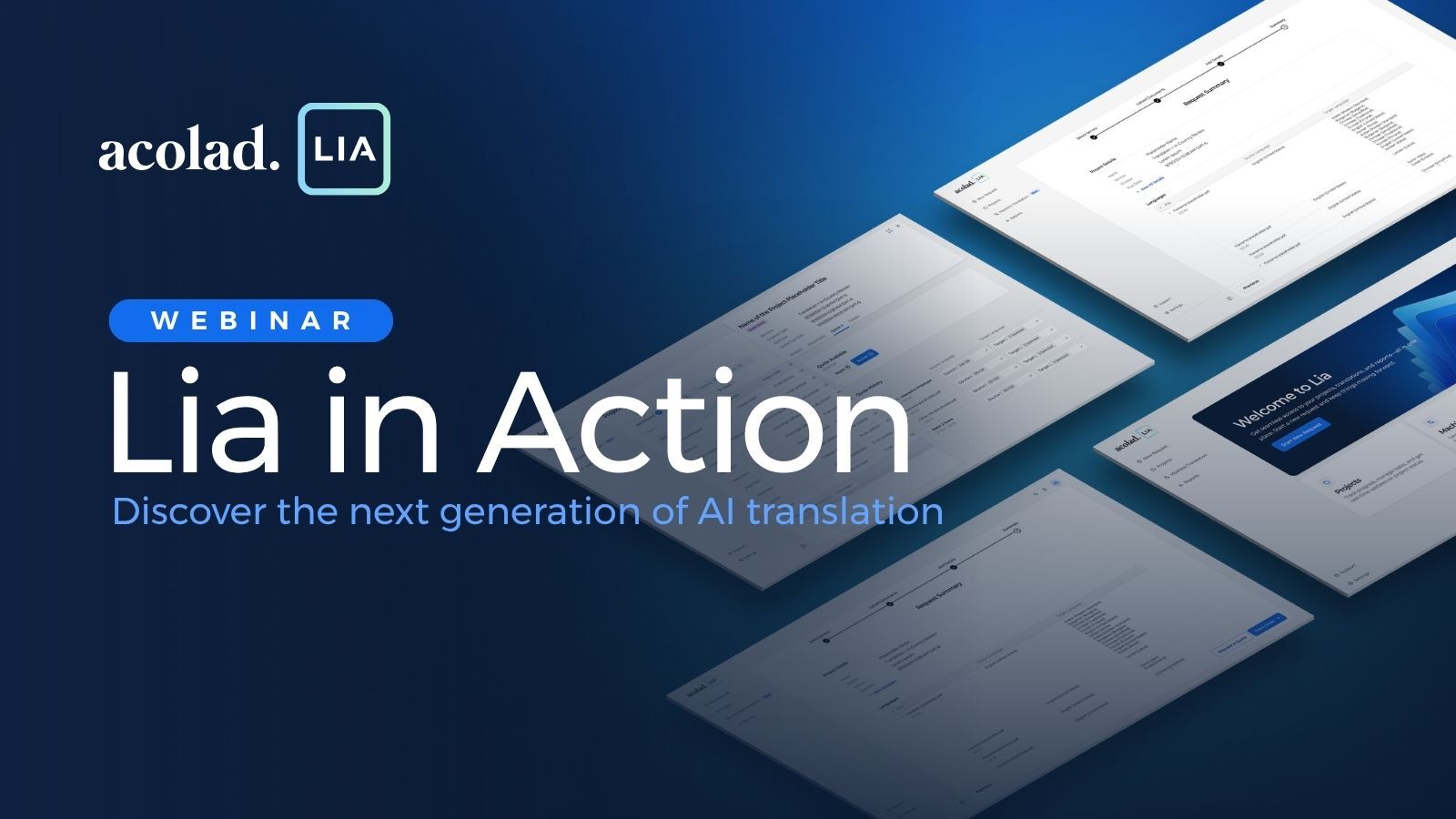
Lia Go sits on the managed side of that line. It pairs self-serve AI with Acolad's language-services operation, built over 30 years as a top 10 global provider.
Routine content moves fast. Teams translate on demand in their own voice. Every request draws on your glossaries, style guides, and translation memory from the first use. Two source-refinement features, Clarify and Enhance, turn rough source text into translation-ready content before the AI runs. Reviewers edit instead of re-translating.
It's one workspace, not five. Lia Go handles text and document translation with formatting intact, plus subtitling, transcription, audio description, and summarization. That's the multimodal coverage most tools leave partial.
Security is built in. Lia Go runs on Acolad's GDPR-compliant infrastructure and holds ISO 27001, SOC 2 Type II, and ISO 17100 certifications. Your content is never used to train public AI models. That removes the exposure of pasting confidential text into a public LLM.
Cost stays predictable, and governance sits on top. Pricing follows task complexity, not per-seat licenses, so you can add a department without a new bill per user. Context management, approval workflows, and usage insights show what's translated, who translated it, and at what quality.
High-stakes content can be routed to expert human translators. For life sciences, legal, or regulated work, that means specialist reviewers and a clear accountability chain.
Key Takeaways
-
Don't choose on accuracy alone. Buyers rank cost, compliance, and safe deployment as heavily as raw quality.
-
Raw engines and public LLMs are fast but ungoverned. They lack translation memory, a human review path, and audit trails by design.
-
Lia Go's edge is the model behind it. Self-serve AI is backed by Acolad's expert linguists. That matters for content where errors carry legal or commercial weight.













.png)