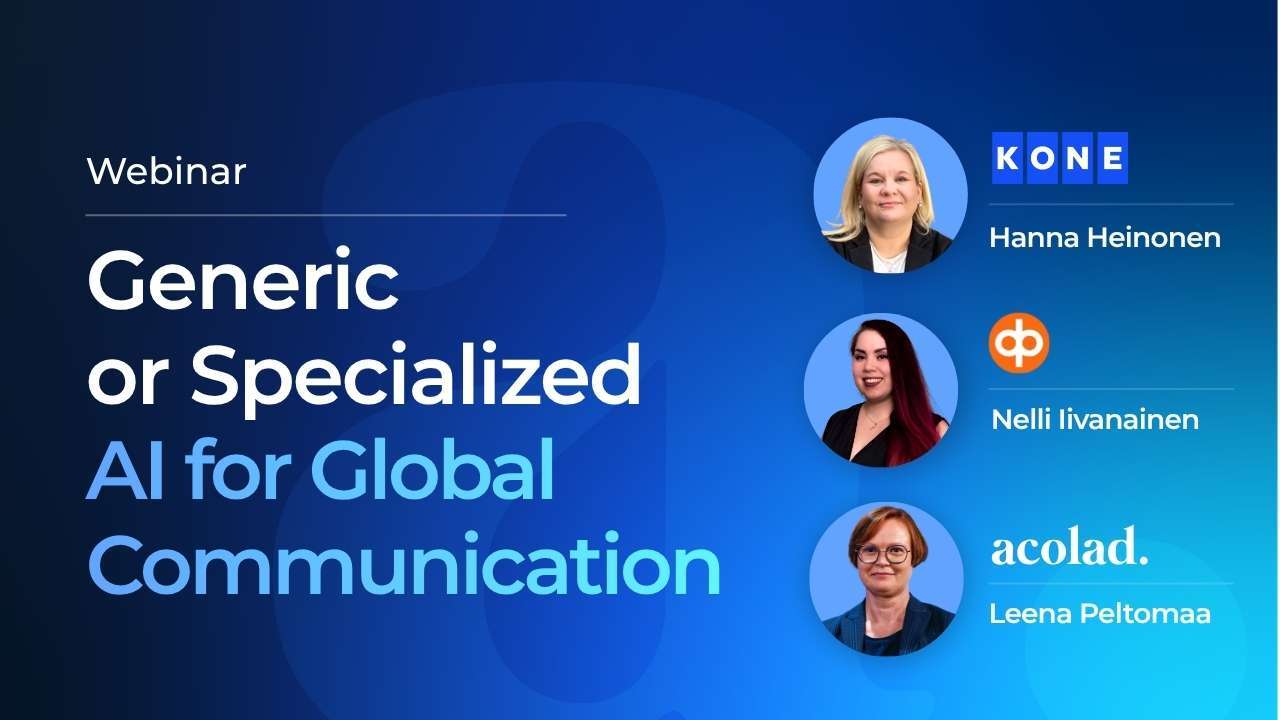




Hello everybody, and you are all very warmly welcome to our webinar, which is about the topic Generic or Specialized AI for Global Communication. We have an exciting lineup for today, people from OP and KONE talking about their practical implementations and real world cases. Before we dive into the discussion, we are going to do a very short introduction. Maybe we'll still give people one minute time to join before we kick off with the actual presentation. My name is Lena Peltoma, I work at Acolad as a global solutions manager since several years, and I am especially focused on AI solutions and how AI can help in global communication and translation workflows. That's my specialty area. And I am still waiting a little bit. And now let's let's start. So welcome everybody. We are going to talk today about generic or specialized AI. And before we go into the very interesting panel discussion we have with Nelli Iivanainen from OP and Hannah Heinonen from KONE, both of them experts in multilingual communication, let us give the topic a little bit of context, a little bit of background on why we are talking about this topic, why it matters for most of us when we are considering how to use AI, how to apply AI to our communication workflows. Before we start with the presentation, I would like to ask you a question, so please go to Slido. You have the link there and the number of the session. So please tell us a little bit about what kind of AI tools you are currently using, especially for content generation or language-related tasks, like translation or review, proofreading, or anything like that. Okay, I can see Claude, ChatGPT, and Canva. ChhatGPT is popular. Also tools for multimedia, like Elevenlabs, Copilot by Microsoft, yes, that's probably very widely used in many organizations. ChatGPT as well has been the market leader for a time now, of course. Claude is maybe getting a little bit on the same level, but apparently not in this audience. ChatGPT and, as I was assuming, Copilot seemed to be leading at the moment. Cat Tools. Yes. Okay. And there are still people typing, so I will let them answer. Perplexity. Okay. That's interesting. I like perplexity myself quite a lot. Gemini. Yes. Gemini has actually performed quite well in translation tasks according to benchmarking results. Phrase AI? Yes, that's a good one as well. And internal tools. Okay, we have a pretty clear picture that there CoPilot is the most common one, the most common choice, and then there are other tools that are also used a lot, such as ChatGPT especially, and then the more specialized tools are maybe in the minority. Okay, let's dive into that question a little bit further. Does it make sense to use generic platforms, like Copilot, for instance, or does it make sense to use more specialized platforms for global communication tasks and translation tasks? We can go to the next slide, please. As background thought, as an introduction to this topic, I wanted to quote this survey by McKinsey. This is already from last year, but from the end of the year, McKinsey publishes on a regular basis a State of AI report. And in the latest version of that report, they were analyzing, for instance, this question that we have here: How can companies create the most value, the most real business benefit from AI adoption? And the answer is that, unlike most companies that have started, it's not really about productivity enhancements or getting savings in terms of time and money from individual workflows or on a personal level, because that is not going to be durable competitive advantage. Everybody can do that. So it's not any different compared to others on the market. Instead, the companies that get actually the biggest business benefits from AI adoption are the ones who use AI to transform their core business processes and workflows, and maybe also to sort of rethink their whole business. In a way, this is very logical results, but it's also food for thought when we consider the question of generic versus specialized platforms. How should we use the different tools out there to get to this point? And if we go to the next slide, please, other consulting companies beyond McKinsey have also published similar advice, similar results from their own research. Here are a couple of points from Boston Consulting Group's research from end of last year, where they focused on the same question, how to really create business value from AI and how to differentiate by adopting AI. Similarly, as McKinsey, BCG said that it's about business transformation, AI first processes rather than improving productivity by, for instance, doing translations yourself, or by generating content yourself instead of going for vendors. And what's maybe even more important in this study is the fact that, according to BCG, companies should really only go for AI adoption when there is real business benefits. So anything that is in terms of money spent or time spent not worth it should not be relevant for most of the AI adoption processes. Boston Consulting Group also looked at or gave some advice on how to do this. There are two points here which are interesting for our topic today. First of all, they said that companies should have a shared common AI platform that is accessible for at least most of the employees at the company, because if it's isolated, if it's siloed in, and there are different tools used in different teams, the benefit will also be smaller. At the same time, the common AI platform should be built on a business context, so it should be fine tuned and customized with the companies and industries specific information and data, and for that, of course, you need to have good data available. In addition to that, there should be strategic, so only where it makes sense type of AI partnerships and technology solutions. If we then transform these ideas to global communication and try to think about how those ideas could be applied to communication use cases and tasks. We can see similar pros and cons for generic and specialized platforms in this area. For individual level productivity enhancements, it's usually very easy to deploy, start using Claude or Copilot or Gemini, and you can get marginal benefits from that as well. But because of what I just quoted from Boston Consulting Group, because customization is usually needed, and personalization, maybe also building some additional layers in the system, like, for instance, agentic workflows, it's not as easy as it may seem on the first look. On the other hand, if we look at specialized platforms like or maybe TMS systems like Phrase, for instance, they are usually very good at the tasks that they were designed for, translation, for example, but of course limited to those tasks. So you could not share necessarily a specialized platform like that with everybody and get the same level of benefit for everybody. And also on this side, personalization and customization is very important. If you have generic models or generic platforms, you will get generic results. Are these systems capable of what McKinsey was looking for or advising to do? Are they really able to transform business processes or core business? Generic platforms, as BCG also noted, are usually embedded in other systems. Think about Microsoft Copilot. It's if the company already runs on Microsoft Stack, it's very easy to add that for everybody. But then again, even if it's accessible and available, it's not necessarily bringing actual business value, at least not on significant level. And then there are, of course, several other things that need to be taken into account, and we talk about these a little bit later as well, in order to be really business enablers and business transforming, both generic and specialized platforms would need to be compliant, they would need to have some risk management features, they would of course need to be secure, and this is very different, the level of these things is very different with different tools. Generally speaking, I would claim that specialized platforms tend to be a little bit better in this area, because the vendors working or providing specialized platforms can't afford off not thinking about this, whereas then the providers of more generic platforms have both enterprise clients, consumer clients, and a very large variety of different types of users, so they may have more room for differentiation there. With these thoughts around how AI should be adapted to global communication and other business critical tasks. We will now dive into real world examples and knowledge and experience with our great panelists, Nelli and Hannah. Hannah works as digital content lead at KONE, and is especially knowledgeable about multilingual documentation and information management, whereas Nelli is from OP POHIOLA, working there as language technology lead, and her experience is related to OPA's translation and multilingual communication needs. Welcome both. Thank you, Leena. Thank It's great to have you here. Let's go right into it. My first question to you guys would be, where are you with your AI adoption today at your respective companies? What do you use AI for? In what way? Are you still more in the experimentation phase or already scaling up with whatever you're doing? Maybe, Hannah, you can start. Speaker 2: Hanna Yes. So we started actually quite heavily investigating the use of AI a couple years ago already, so we've been implementing we have two different, of course, different journeys here. So one thing is our r and d processes when you are working in an office and and doing r and d type of work. So most people use do utilize AI to some extent. Might be just a simple question to that co pilot. How do I find find something in the company infraNET, which is typically a difficult place to find anything? So to facilitate that type of work in R and D. We've also been now, I think all of the all of the r and d r and d people are now encouraged to actually look deeper into into utilizing AI agent, for for example, to get rid of manual workflows within within the work that they do. But then the the second side of the story is our field work, where we actually do the work that customers see. So when we talk about our maintenance, for example, we have implemented a a a conversational AI chatbot that is the first layer of support for our maintenance technicians. So that is actually I see that as a well, it's an AI, of course, an AI enabled service, but that is more like an accessibility or findability feature into the vast amount of information that we do have available, but people probably cannot find. If they're working in the field, they cannot they don't really have the time and patience maybe to look into different information sources, for example. So that has been rolled out to field, and I think it's live now in in thirty thirty plus countries and really, really well received there as well. So I would say that we are there. There are things to do still, but quite a lot already has been. Working well already and scaling Yes. And I think that basically the main feedback has been positive in a sense that people do see benefits there and see that you can do that. There is, of course, some confusion on what should I be doing now still. I think there are clear, like, paths now where to go and also how how you can actually then utilize. And, also, people are coming up with their own ideas on how to replace those manual workflows with with AI, which is a good thing a good thing. And everybody is encouraged to do their, like, own thinking there, so it's not managed by just a couple of people. It's, like, more, like, crowdsourcing of ideas, sharing and and demoing and and sharing your prompts with others. Sure. Sharing also the experiments. Is there any specific technology that you're especially building on? Or is it Yeah, of course, we have a copilot for for everybody, but we actually do have a setup where we can test and use several different different LLMs, so it's not restricted to that. On the on the fieldwork side, we are using then Claude, but we can maybe go that's more like a specialized thing, we can go into that maybe further. Yeah. Further in the How about in OP Group? You're, of course, operating in a very strictly regulated industry. So how is your AI adoption journey going at the moment? Well, here at OP Pohela, we have a very similar situation as Hannah was describing at, like, very huge scale of of experimenting and already implementing very, very critical AI functions that create real customer value already. But then, of course, there's a lot of new possibilities arising every day, so it's hard to keep up as well. The case is really fast. Yes. But here in our team, like service language services, I think we are in a good pace of really have already implemented AI features that are very critical for us. And and then we're also experimenting with new possibilities every day. And as Hannah was saying, we already also, like, a few years back already started to get all things set up because the data governance alone with AI is is a huge task. So I think we're also in a good place and finding out new solutions every day and the real task I think is removing all the noise and staying in some kind of lane that you need, like really thinking about what you want and what you need, not only just getting every kind of tool onto your plate and then you don't know what to do with them. So so it's a fine pal balance to really see what is useful for you and what do you need it for, because it's not only just speed or money or value. It's for us, it's it's quality. So where can we find quality? I think it's a very good thing for everyone. And I'm sure, Hannah, you also agree that I agree. Quality is the first thing. Yes. It's definitely a fine balance of in Yeah. To try out things, but then streamlining what you actually go are going to be using because then, otherwise, it will be really, really scattered and people doing other you know, lots of different things. But then I at least do feel like we also want to give room for some experimentation, otherwise innovations do not grow if you're actually in a really, really restricted environment. It's a fine balance. Yeah, exactly. And you need to have the experimentation to some extent to even learn about the capabilities and possibilities and to identify the use But then, as you both mentioned, at some point, you need to move from that to and maybe the piloting phase to actual business implementations, do you guys have in your company certain criteria for that particular transition from pilot or experimentation to production, actual implementation, what needs to be there for a use case or for a tool to make it over that fence? You mentioned QualityNelly. That the main thing that you are looking for? In our team, yeah. In our team, it really is about what tools actually work and what tools actually help our linguists to do their work and what kind of ways we can then scale up to a whole of Apepohela employees to really use in their language needs. What can we share with our expertise that they can use in their daily lives and not just have everyone using different tools creating content in languages because there's a place for that as well to create language content by themselves and then there's the place to get professional translations and how to really bring these two together and also remain in control. That's the real task right now. Yeah, from our point of view, we have a strict legal review and cybersecurity review of course, because we are working with confidential information within our R and D, and also the information that we use in the field is also of course confidential in many ways. Lots our competitors would, of course, like to know the deepest secrets of our r and d. So that is the first layer that there it needs to be something that actually works inside of our own organization and doesn't go anywhere there. Then quality quality wise, when we talk about especially when we talk about user user support and and, helping people people with information in a really high risk environment, we do have a lot of standards for what type of information we actually want to deliver. And especially when we move into multilingual information, how do you make sure that it's all basically one to one with the exact risk assessed version that we put out in English first? So there are multiple layers to this, but we do need to keep a really good control of the information that we have. And then, of course, the tools are the main facilitators in that governance there. Indeed. And I suppose that's an area where most companies, especially the bigger ones, will will put a lot of attention to, because it's definitely business critical to keep the information confidential. It's crucial. And there are, like, example cases not inside of CONNECT, but, like, you I've seen in the news, of course, when the the secrets are spilled basically outside of the organization by somebody using a a a public chat GPT instance somewhere, and that's putting putting it out there. So definitely, this is a there used to be, like, a more maybe this type of hacker type of thing people are going in there, but then maybe this is, like, bigger threat in these days. There are lots of cybersecurity rule rules and firewalls on how do how do you actually keep outsiders not accessing your network. But then if you have your own people not knowledgeable on what they can actually put out there and what tool is safe to use, then, of course, that poses a lot of lot of security risks. So it's a definite definite difference between between operating inside your own own network on your own servers versus the public public domain. And there has also been a lot of talk lately about the so called shadow AI. So people just go rogue and using whatever they use because it's easy and it's there. But then, of course, sometimes the the security risk is forgotten. Go ahead, Nelly. Sorry. I didn't want to interrupt you. No. No. I was just agreeing that I think that in inside of bipolar, there are different, like, rules inside teams that they assess what kind of tools they want to use. But then, of course, the the overall rule is the same as Hannah was mentioning that data governance and and and like safety first is the first rule. So, Nelly, you mentioned earlier that you are trying to find the balance between something that everybody can use at OPE and the things that are more for professional translation. So can you give us some concrete examples of the technologies and use cases that you have on your side? Sure. Well, this is something that we are looking into and experimenting still, but I think there would be a place for a tool that would be accessible for everyone in the company that would be like a style guide type of agent that would go through, help people with their content that they've maybe created with AI or translated via AI or written by themselves. And then they would have like this coach with different languages, with different even text genres and different like different places where they publish it. So this is something because there's no one size fits all. There is no such thing. So how to find ways to help people create high quality language versions of text that are suitable for, like, self creation and with AI. Self-service use cases? Yeah. And for professional translation, you use phrase. Right? Yes. We have phrase CMS and strings, and and we use that for professional translations where, for example, the the data is very well protected or it's very, very demanding or high governance or anything like any anything like that. And and because we work with Finnish to English and Swedish mainly, there are lots of text genres that would make no sense to have the actual substance specialist to translate. Their work is not to translate it. Their work is to have responsibility from the source text. And then it would be, I think there's no point using their valuable time to really create the language versions for such demanding texts or even smaller texts either way. What about on your side, Hannah? You mentioned some technologies already earlier. What are you using for the different types of tasks, professional versus more generic, etcetera? Yeah. There are definitely on on also multilingual communication side. There are different use cases there. So the maybe the simplest one is that you get an email where there's been a back and forth discussion in in Chinese, maybe between two Chinese colleagues first, and then somebody's added there. So you actually want to know what is there. So that is, like, the simplest thing. You can actually translate that with something. We are using phrases now. Phrases well there, you can probably use Copilot for for that one as well because that is, like, the lowest threshold in a way. You just need to on a need to know basis. At the other end of this thing is, of course, like a big press release where you actually want to be definitely exactly like it is, communicate whatever the tone of voice and all of that that comes into the play. And in between, there are multiple, multiple use cases of of different things. So I think, in a way, you cannot really even find one tool for all of this. So there is definitely a a a, like, a selection of tools that you can use, and then you pick and choose the one that would be appropriate for the job. I definitely feel like on our side, when I talk about maintenance guidance, it's definitely something we want to still get validated by humans, but there are multiple things where actually machine translation already is good enough in some of the language. One interesting thing in a global company is that even though you think that you have for example, KONE has been doing a lot of translations for years and years and years. So we have a lot of translation memories into many, many, like, let's say, main languages. But then suddenly, you start implementing, like, new languages. So we've been looking into many of the Asian languages that we actually haven't typically done. So, for example, now experimenting with eight different Indian local languages, which is a totally different game than using English to German or English to French translation and how what type of technology would be suitable there. So is it actually going to be well, I'm still in the progress of trying to evaluate evaluate that, but it's an interesting thing because I think the world is becoming smaller in a sense with every single introduction of a technology that facilitates a lot of the communication. But I don't think there is one size fits all type of tool available for all of this. Think, Nelly, you would agree on the other side as well. True. I can relate to that as well. And as you mentioned, the Indian languages there, Rohan, that's one topic, of course, that needs to be taken into account when we talk about multilingual communication, that not all languages are equal in the sense of how much data there is in the world for the training of the models, and not all models are equal in the sense of how much, for instance, Indian content is there in the training material. So the outputs could be very different. It can be even seen in Finnish to Swedish alone. It's a very rare language. Finnish and Swedish are small languages. They're much smaller than the Indian locals. I think they are much bigger. Yeah. There are millions and millions of European local languages. Yeah. So so it's hard to really find a model that would be truly helpful with, like, Finnish Swedish, it's not the it's very surprising and not surprising at the same time that that there really isn't a tool right now that would be very reliable to to use generically, maybe better generically than in professional translation. So that's an issue we're facing and trying to find solutions. It's an interesting thing because there are actually a lot of, of course, you can say, just translate with Copilot and it'll be fine. But there are actually so many different nuances to different languages and how it actually sounds then natural to the user. So Yeah. You can do that machine translated type of thing that sounds fake to multiple language. But if you actually want to catch the actual tone of voice and the actual intent for the intended audience and catch the actual user experience, make it better. So it's not that simple. So there are many, many things that you actually have to take into account. That's true. Even in the era of AI where you think that AI can handle it all. But I think and I hope that AI kind of amplifies the places where humans are truly needed, and from my point of view, translators, linguists are actually very, very needed in the era of AI because AI does skip the most important part of translations because the linguist is trained to really understand the text and see what it really tries to convey. AI does convert the text from a language to another and skips the part of what Hannah is saying here. Some language is better than others, but still I think there's so much room for the human review and really finding out what's because a very important point I think gets overlooked quite often is that if we could have a flawless source text, the perfect source text, then AI would perform quite well the source text usually you to read a lot in between the lines in many cases AI is not that good with it. It's vague. It has mistakes. It's something that someone needs to understand first in order to convey it in another language, not even like in terms of style or fine tuning or like getting it very good, but really understanding the text. And this is what AI does, do the way that we do. And when you move actually into a really specialized domain, like we Yeah. Talk about elevators, There isn't there is, of course, some information in the public LLMs about, you know, elevator and the buttons, but there is a specific language that actually governs this whole. So you actually do have to have a a specialized tool that actually understands that nuances. Otherwise, it will be total total, you know, not natural at all for the users. So it's it's a totally different thing when you actually start talking about, like, a specific specific terminology that is Yep. In within that domain. The same with finance, of course, that there are specific things. If you try to, you know, translate that with with an LLM that actually understands dinner recipes, so it's a it's a different game. And in our might you know, we don't we want everybody to go back safe at home, you know, at the end of the day. So we don't want anybody falling off the elevator car roof when they're maintaining it. You don't wanna lose anybody else's money, of course. So it's a we're not talking about, you know, making a, let's say, wrong direction, but taking a wrong turn at the end of the street here. But it's bigger things that are at play here. You are actually already talking about the final point that we had in the discussion, which was risk management and governance. Some very good points there about that and how important it is and what really big risks there might be. And it also, I think, ties to what I was saying earlier about the need for customization and personalization. So of course, you can use generic models, but you need to guide them with terminology, with existing translation memories and assets like that to get any specific outputs. But maybe on that topic, still there is I see there is a question from the audience about at what point did you need to involve legal or compliance in the discussions related to your AI tools that you're using? Any comments on that? First thing. Right at the beginning. Yeah. Yeah. We are have set the threshold so that you can do, like, a proof of concepts without that. But then once you move into a piloting with real users with anything, then you do have to have a a some type of a type of a legal review, and then moving on to full production requires the full review. So there are, like, different steps to take there, so you can still experiment with some things. But if you want to start rolling out things, then you need to do the legal things, of course. Exactly. There is also another question from the audience related to the same area of topics? Has there been any security incident or a near miss that has changed how you govern AI use internally? Nothing comes to mind. I think careful. Even today we are still like maybe doing some safety steps that wouldn't be necessary anymore, but I think we were at the beginning extremely careful and maybe like ruling out everything and then step by step, like checking out if it's okay. So nothing comes to mind like we I think we've had a lot of guidance from the beginning, not to be careful. I think the same thing kinda applies to, like, a previous like, if you talk about, like, translations. So do not use, like, a a public instance of DeepL to translate or that type of thing. Because if you copy paste anything into the public Internet, then it will be free for anybody to anybody to access. So I think that has been also used as an example for quite a lot of lot of time. So we haven't had any bigger breaches, but, of course, it's also difficult to say once something goes outside of you, cannot even see it immediately. So if it goes somewhere, it might be somewhere, somebody might then access that later on as well. So so but we I think it's a good thing that you actually set the rules rules from quite early on to understand what you can do, what type of tools you can do, and then also brand brand your tools so that it's evident that if you are using a public public tool or if it's something that is company company approved in a way. So that also gives a clear indication. We try to stick the Konell logo to every single tool so that people know that they are in a safe space and can also experiment there. Before we take the rest of the questions, or at least as many as we can within the time, maybe as final words from you guys, any advice about what you think every company should do or specifically not do within the next three months in terms of AI adoption for multilingual communication? Nelly? Well, one thing that has been really valuable is I think it's interesting because there's been a lot of I think people are saying, wow, I didn't even know that we had this type of thing, because we've been doing terminology work for thirty years or so within r and d. So we have a wealth of information both in English and then also in multilingual formats. So that's that has been really valuable for the AI. So that is a good thing to start. So if you don't really have that type of a thing, at least start with the basic terms that would be within your own specific domains and start mapping those out. Because then once you actually AI understands your domain, it's definitely then far more efficient than just the public trained LLM. Good old terminology Data. Yeah, I know. It is somehow connecting. You have lots of data, and then once you actually can turn that into more more smart information through the glossaries and terms, then that actually becomes a big IPR for the company. Indeed. What about you, Nelly? Yes. Thanks. I think I was thrown out for a minute, but I got back. I think that the the most important thing would be, there's lots of important things, but one important thing would be to have specialised people taking care of the specialised tools. Like in order to get real value from the tools, you have to have people that really know how to use them and really know how to produce quality with them. And I think that would be a good thing to invest in. And these people are the people that can take care of terminology and take care of the data and really see how they can use the data to create true value. Experts in linguistic data and I'm I'm having some experiences where where it's all, like, IT and all coding and all all knowledge of different fields, which is important, but I need linguistics in in the language technology as well, not just technology. Yeah, exactly. Exactly, that's a great tip, as well as the one about terminology. If we still take a couple of questions from the audience, I think this is an interesting one. How do you handle pushback from teams who are already using their own AI tools and don't want to switch to anything company approved? Well, finding them, of course, is difficult, because they're usually hiding under their tables. But I think we do try to set an example by demoing and showing what you can do with the company and trying to find basically the things that we've, for example, built a a platform at Connet, which is the AI the AI platform for everybody. And once you actually implement something on top of that, you get the benefit of of the work that has been done for other teams as well. So you don't have to start from I think showing good examples also showing maybe the bad examples and the failed failed ones is a good good process there because then you are the visibility into the things that people are doing is and and setting the examples through that, I think, is the key there. Within our our team, we have sixty six thousand employees now and probably doubling doubling soon soon with the merger. So it's difficult to go and see ask everybody, hey, what are you using actually for that? So governing by showing examples is the key there. Yeah, I think I agree with Hana. Well said. Maybe as a final question, and also I think this serves well as a conclusion, this is from the audience, not from me, but it ties into my introduction. If you think back to the principles introduced at the beginning of the webinar, where would you say that your company is now with your AI efforts? Are you still in the stage of improving efficiency and finding savings, or have you moved to the stage where it's more about business transformation or actual business benefits? I think Johanna said something about this already earlier, but maybe you can Yeah, I can recap. So we've definitely done and partly we are, of course, always trying to improve the efficiency and trying to find that way, but I think we are definitely moving into the business transformation area where we're looking at agentic AI and how we can transform, for example, our predictive made analysis with that. So we are moving away from that chatbot era of somebody asking a question and then the AI answering, and then relying more on AI to predict some of the things and and also then predict what should be done there. So definitely moving. But there's a lot to do, so you cannot just go and replace manual workflows with AI. So I think you have to definitely have to look at the whole process and see how you actually reconfigure and transform that process so that it fits fits into the new new technologies as well there. So not just replacing, getting rid of and then also wonder that also love then defining what is the role for the humans in the in in that new process there. So we definitely do not want to give up the process to the AI fully, No. Definitely not. Any comments, Nelly, from your side? I agree with Hannah. Think these go hand in hand simultaneously because there's so much to do and some parts are in another stage than others. The agentic workflows are the thing, I think, that are next to really automate where it is sensible and really mapping out the things that humans do better than AI and where we can unite forces to get the best results. Indeed. Good final words as well. I think our time is up, so we need to end this very interesting discussion, even if I'm sure that there would have been more to say from you both. Maybe at some later stage, we can get back to the topic. But for today, many, many thanks to you, Hana and Nelly, for your inputs and for the interesting discussion. And of course, also thank you everybody who joined us, and thanks for the good questions as well. Thanks. Thank you. And we will get back to you with the webinar recording, of course, later on for RIK. Great. Have a nice day! Thanks, Bye!