




Every time a colleague pastes content into DeepL or another public AI tool, your localization team loses a little more visibility: no record of who translated what, or where the data went. Getting that visibility back is the real job, and the most capable DeepL alternatives for enterprise teams do it by pairing fast self-serve translation with central control, governance, and human review scaled to content risk.
When translation spreads across teams with no central record, brand terms drift, regulated content ships without review, and IT can't answer a basic audit question: what did we translate, in which tool, and where did the data go. Choosing a DeepL alternative is less about a better engine and more about getting that control back.
What to Look for in a DeepL Alternative
DeepL is a machine translation engine. Machine translation, or MT, is software that translates text automatically without a human. It works well for quick drafts and internal documents. For an enterprise localization team, though, the translation step is only part of the job.
The real question is rarely "which engine is most accurate." It's "which platform gives my team speed without losing control." That shifts the checklist from raw output quality to how the tool fits your operation.
No tool wins on every line. The point isn't a perfect score, it's knowing which criterion is your hard constraint. A regulated team weights governance and data control first. A fast-moving product team weights self-serve speed. Rank the six criteria for your situation before you compare vendors.
Six criteria decide enterprise fit when you compare DeepL alternatives:
Workflow depth. A translation management system, or TMS, is a platform that manages the full localization process, from content intake to translation memory, review, and delivery. An engine handles the sentence. A TMS handles the process around it, including roles, approvals, and reporting.
Governance and traceability. Can you see who translated what, in which tool, with which data? This is the gap that shadow AI creates. Shadow AI is the unmanaged use of public AI tools by staff, outside any approved workflow. Without a record, an audit becomes guesswork.
Data control. Where does your content go, is it used to train public models, and can you meet GDPR and the EU AI Act? For regulated content, this is a pass-or-fail question, not a preference.
Self-serve versus managed. Can teams translate on their own today, and is there a path to expert delivery when content carries more risk? A tool that only does one of these forces a trade-off you'll feel later.
Human review by content risk. Human-in-the-loop translation is a workflow where professional linguists review or edit machine output before it ships. High-stakes content needs it; an internal memo doesn't.
Predictable pricing. Per-seat, per-word, and usage-based models each behave differently as volume grows. The model that looks cheap at pilot scale can become the one you can't forecast.
When DeepL Is Enough, and When It Isn't
DeepL earns its reputation. Its translation quality for European languages is strong, and its glossaries, style rules, and translation memory (a store of previously approved translations, reused to keep wording consistent) help teams stay on-brand. For fast drafts, internal content, and low-risk documents, it does the job well.
The limits show at enterprise scale. As of 2026, DeepL is an engine with glossary, translation memory, and CAT-tool integration, rather than a full workflow platform. It offers no managed human translation service, and its project management, roles, and multi-step review orchestration are thin next to a TMS. Teams also report a lock-in consideration: translation memory export is limited to certain language pairs.
The business impact compounds quietly. The language services market reached USD 30.85 billion in 2025 (Slator 2026), and enterprise buyers are consolidating fragmented tools to regain visibility and control. A stack where each team runs its own AI tool works against that goal. It multiplies vendors, scatters translation memory, and leaves no single record of AI use. When an audit or a data-protection review lands, that fragmentation becomes the first problem to solve.
So DeepL is enough when the content is low-risk and the team is small. It falls short when several teams translate in parallel, when someone must sign off on regulated content, or when IT needs an audit trail across the whole operation. That's the point where a DeepL alternative built for enterprise localization pays for itself.
"Many executives think that you can just put raw text into a generic AI and you will get perfect results. This is definitely a misconception."
Stéphane Cinguino, Chief AI & Technology Officer, Acolad
The Main DeepL Alternatives for Enterprise Teams
Four platforms come up most often when enterprise localization teams look past DeepL. Each takes a different angle, and the right one depends on your first constraint.
Smartling is an integrated translation platform that combines a TMS with managed language services. It holds ISO/IEC 42001:2023 certification for AI management systems, awarded in 2026, which puts it ahead on formal AI governance. It suits teams that want deep workflow tooling and audited AI controls. Alongside ISO/IEC 42001, it maintains ISO 27001 and SOC 2, and offers AI-only, AI-plus-human, or fully human delivery. It sells through a sales-led, custom-quoted model rather than instant self-serve, so expect a procurement cycle before you translate.
Phrase is an AI-first TMS. It was named a Leader in the inaugural Forrester Wave: Translation Management Systems, Q3 2025. It routes content across multiple engines and exposes its stack through an API, which makes it strong for automated, developer-led pipelines. It combines a TMS, string management, and multi-engine AI in one environment, and holds ISO 27001 with SOC 2 in progress. Its self-serve entry has narrowed through 2026, and its pricing moved to a word-metered model, so product teams should check current tiers before committing.
RWS Language Weaver, paired with the Trados TMS, offers cloud, private-cloud, and on-premises deployment, which matters when content can't leave your environment. Language Weaver supplies secure MT while Trados provides translation memory, terminology, and workflow orchestration, with ISO 27001 and ISO 17100 in place. It runs as a custom-quoted enterprise engagement, not a self-serve signup.
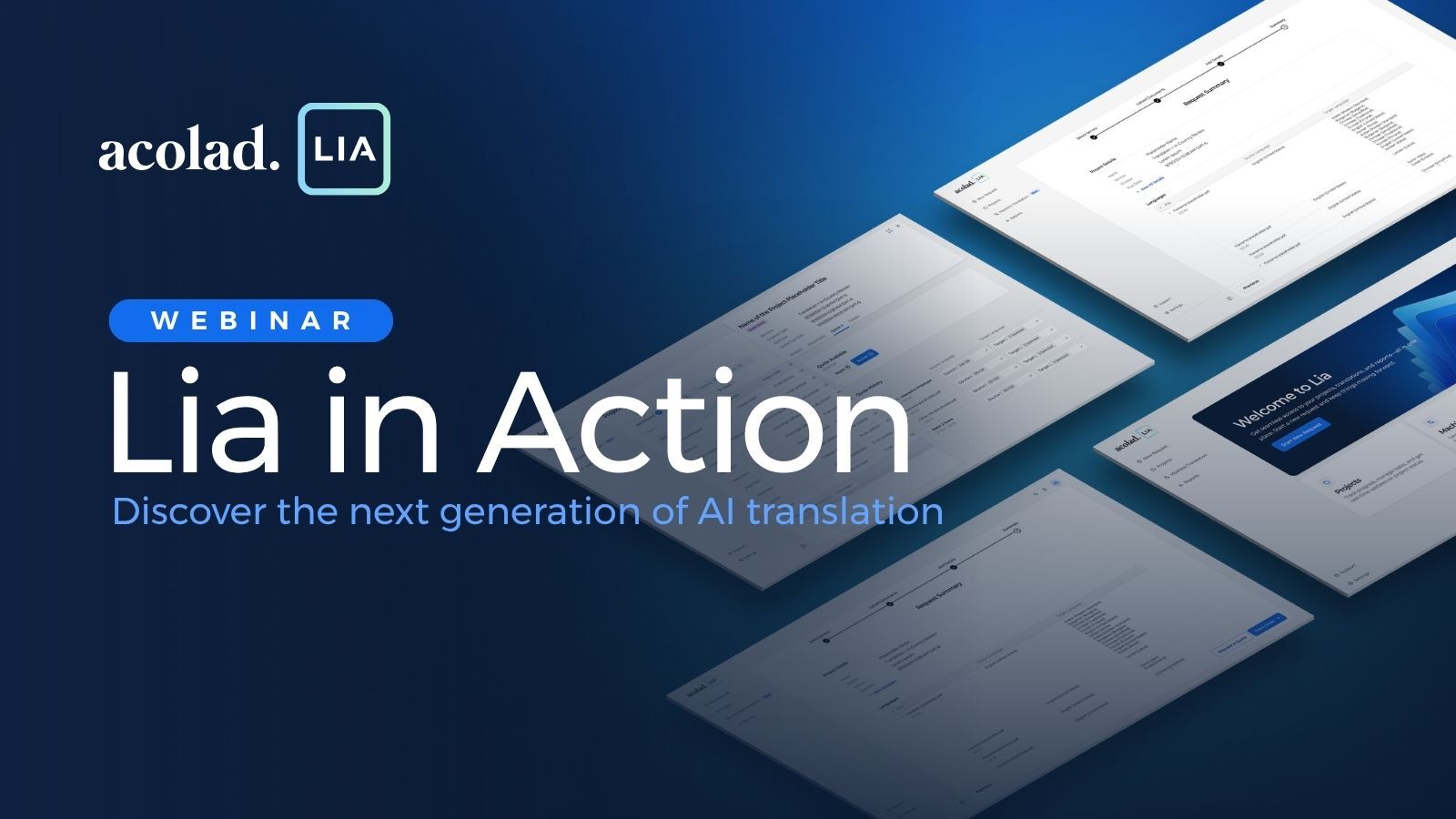
Lia Go, Acolad's self-serve AI localization platform, sits in a different spot. It's covered in the next section, because its angle is the one the other three only partly offer.
Here is how the four compare on the factors that decide enterprise fit:
| Platform | Type | Self-serve | Human-in-the-loop | Standout strength |
|---|---|---|---|---|
| DeepL | MT engine | Yes | None (software only) | European-language MT quality |
| Smartling | TMS plus services | Sales-led | Yes, managed | Audited AI governance (ISO/IEC 42001:2023) |
| Phrase | AI-first TMS | Narrowing | Via external provider | Multi-engine routing, API-first |
| RWS Language Weaver | Secure MT plus Trados TMS | No | Yes, managed | On-premises and regulated deployment |
Vendor details reflect public information as of July 2026
"Tools like DeepL or ChatGPT or Gemini in and of themselves give fast and pretty generic outputs, but they lack an in-depth context, accountability, brand precision and consultancy."
Petra Angeli, Head of Global Solutions, Acolad
Where Lia Go Fits
Most DeepL alternatives ask you to choose upfront: a self-serve tool or a managed service. Lia Go removes that choice. It's Acolad's self-serve AI localization platform, and its distinguishing feature is the path it opens, not a single fixed mode.
Teams start self-serve. Marketing, product, and content staff translate on their own, with shared glossaries, style guides, and translation memory keeping output on-brand. Two source-refinement features, Enhance and Clarify, improve the source text before translation, which lifts quality without adding a separate tool.
The difference shows when content carries more risk. Lia Go connects to Lia Services, Acolad's managed delivery model, so a regulated document can move from self-serve translation to review by specialist linguists without changing platforms or losing data. The localization lead keeps control of terminology and traceability while teams keep their speed. (See Lia's approach to AI translation governance for how that control is built in.)
For the localization lead, it means keeping brand and terminology control as translation decentralizes across teams. For the AI strategy owner, it means AI use stays governed and traceable rather than scattered across public tools. Both keep what they need without slowing anyone down.
Consider a financial-services localization team. Marketing translates campaign copy self-serve, at speed. A regulatory disclosure, by contrast, routes to human review under the same governance and the same translation memory. One platform covers both, keyed to content risk, with no second tool to buy or re-learn.
Data control sits inside the platform rather than bolted on. Lia Go runs on Acolad's enterprise security foundation, with ISO 27001, SOC 2 Type II, and ISO 17100 certifications and GDPR-compliant infrastructure, and content is never used to train public models. For a team under a data-protection review, that record of what was translated, in which tool, with which data, is the answer IT has been missing.
This self-serve-to-managed path is where Lia Go is genuinely different. DeepL has no managed service. Phrase depends on an external provider for the human step. RWS offers little self-serve. Lia Go carries both ends on one platform, with content kept out of public model training.
The payoff shows in client results. Our data shows teams moving to Lia Go have cut time to publish from days to hours and consolidated several tools into one subscription, for a spend reduction of around 50%. One global marketing team in consumer goods, working across eight markets, reported dropping from three to five business days to four hours per piece, with localization becoming part of the publishing workflow rather than a bottleneck.
No single platform wins every scenario, so weigh Lia Go against your first requirement. Smartling leads on formal AI-governance certification. RWS owns on-premises and air-gapped deployment. Phrase is deeper for developer-led software string localization. If one of those is your first requirement, weigh it honestly against the self-serve-to-managed path.
"With a platform like Lia, supported by an experienced language service provider like Acolad, you can combine the AI efficiency with 30 years of industry experience. And so this means that your content isn't just generated or translated when you need it, it's also reviewed, it's refined, it's aligned with your brand, your terminology, your regulatory needs."
Petra Angeli, Head of Global Solutions, Acolad
Moving to Your DeepL Alternative
First, find where AI translation already happens across teams, so shadow AI becomes visible.
Second, consolidate translation memory and glossaries into one place, so brand terms survive the switch.
Third, pilot self-serve with one team and set clear rules for when content escalates to human review. Start with the content that carries the most risk, and the rest follows.
The pattern behind these choices is simple. DeepL answers the translation question. Enterprise localization is a control question. The right alternative gives your team autonomy while keeping governance, quality, and cost under your eye.
Key Takeaways
-
DeepL is a strong MT engine, but it's an engine, not a workflow platform: no managed human review and thin governance for enterprise teams.
-
The right DeepL alternative depends on your first constraint: governance certification, on-premises deployment, developer workflows, or self-serve speed.
-
Lia Go's advantage is the elastic path from self-serve translation to managed human review on one platform, keyed to content risk.
-
Score any alternative on workflow depth, governance, data control, self-serve versus managed, human review, and predictable pricing.










.png)